Exercises for Shoulder Bursitis: A Comprehensive Guide (Updated 12/11/2025)
Navigating shoulder bursitis requires a structured exercise plan, often found in detailed pdf guides. Dr. Kevin R. Stone’s techniques
emphasize rehabilitation,
focusing on restoring function and minimizing pain through progressive movements and strengthening protocols.
Understanding Shoulder Bursitis
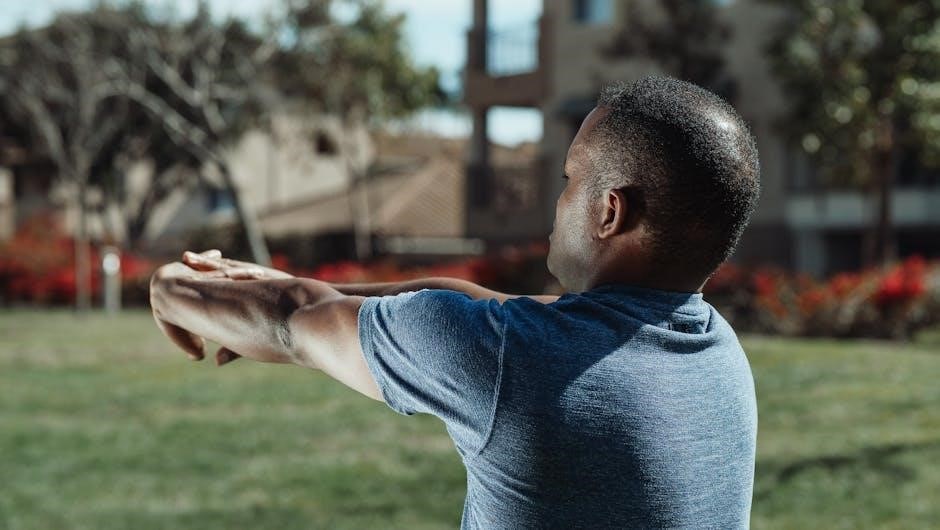
Shoulder bursitis, a common source of pain, involves inflammation of the bursae – fluid-filled sacs cushioning bones, tendons, and muscles near your shoulder joint. Pdf resources detailing exercises often begin by explaining this fundamental aspect. Understanding the condition is crucial for effective self-management and adherence to a rehabilitation program.
These bursae normally reduce friction during movement, but repetitive motions or injury can cause irritation and swelling. This inflammation leads to pain, particularly with overhead activities or when lying on the affected side. A comprehensive pdf guide will illustrate the shoulder’s anatomy, pinpointing the location of the bursae and how they function.
Dr. Kevin R. Stone’s approach, as highlighted in advanced orthopaedic resources, centers on addressing the root cause of the inflammation, not just masking the symptoms. Therefore, understanding the mechanics of the shoulder and how exercises can restore proper function is paramount. Effective exercise programs, often detailed in downloadable pdf formats, aim to restore range of motion and strength without exacerbating the inflammation.
What is the Bursa and Why Does it Inflame?

The bursa is a small, fluid-filled sac acting as a cushion between bones and soft tissues – tendons and muscles – within the shoulder joint. Detailed pdf guides on exercises for bursitis often begin with a clear explanation of this anatomical structure. These bursae minimize friction during movement, allowing for a pain-free range of motion.
Inflammation, or bursitis, occurs when these sacs become irritated. Repetitive overhead motions, direct trauma, or underlying conditions like arthritis can trigger this inflammation. A well-structured pdf will visually demonstrate how these actions impact the bursae. Dr. Kevin R. Stone’s techniques emphasize identifying and addressing these causative factors.
When inflamed, the bursa swells, causing pain and limiting movement. Exercise programs, as outlined in many pdf resources, aim to reduce this inflammation and restore normal function. Understanding why the bursa is inflamed is key to selecting appropriate exercises and avoiding activities that worsen the condition. Proper rehabilitation, guided by resources like these pdfs, is crucial for long-term relief.
Common Causes of Shoulder Bursitis
Numerous factors can contribute to shoulder bursitis, often detailed within comprehensive pdf guides on the condition. Repetitive overhead activities, common in sports like tennis, baseball, and swimming, are frequent culprits. These pdfs often include illustrations of the affected movements.
Direct trauma, such as a fall onto the shoulder, can also cause acute bursitis. Furthermore, underlying conditions like rheumatoid arthritis, gout, or thyroid disease increase susceptibility. Dr. Kevin R. Stone’s approach considers these systemic factors alongside localized issues.
Poor posture and muscle imbalances can contribute by placing undue stress on the shoulder joint. Many pdf resources emphasize postural correction exercises. Even prolonged, seemingly innocuous activities like gardening or painting can trigger inflammation. A thorough pdf will categorize causes based on activity level and pre-existing conditions, guiding appropriate exercise selection and preventative measures for long-term shoulder health.
Symptoms of Shoulder Bursitis
Recognizing the symptoms is crucial, and detailed pdf guides often provide visual aids. The hallmark symptom is pain, typically a dull, aching sensation in the shoulder, worsening with movement or prolonged activity. Pain may radiate down the arm. Many pdfs categorize pain levels for self-assessment.
Tenderness to the touch over the affected bursa is common. Stiffness, limiting the shoulder’s range of motion, is another frequent complaint. Some individuals experience swelling around the shoulder joint, though this isn’t always present. Dr. Kevin R. Stone’s rehabilitation protocols address both pain and stiffness.
A comprehensive pdf will differentiate bursitis symptoms from other shoulder conditions like rotator cuff tears. Pain at night, particularly when lying on the affected side, is a common indicator. Early diagnosis, aided by information in these pdfs, is key to initiating appropriate exercise and minimizing chronic issues, leading to a faster return to function.

Phase 1: Acute Phase ⸺ Reducing Inflammation
Initial pdf guides prioritize inflammation control. Rest, ice, and gentle movements, as outlined by Dr. Kevin R. Stone, are vital for pain management and recovery.
Rest and Activity Modification
Initial pdf resources for shoulder bursitis consistently emphasize the critical role of rest and activity modification. This doesn’t necessarily mean complete immobilization, but rather a significant reduction in activities that aggravate the shoulder pain. Dr. Kevin R. Stone’s approach, detailed in rehabilitation protocols, focuses on identifying and temporarily avoiding movements that compress the bursa.
Specifically, avoid overhead reaching, repetitive lifting, and forceful pushing or pulling. Modify daily tasks to minimize shoulder strain; for example, use assistive devices to reach items or delegate heavier lifting. The goal is to allow the inflamed bursa to calm down.
Gradual return to activity is key. As pain subsides (guided by a physical therapist or physician), slowly reintroduce activities, paying close attention to any recurrence of symptoms. Ignoring pain signals can prolong the healing process and potentially lead to chronic bursitis. Pdf guides often include a timeline for phased activity increases.
Ice Application Protocol
Numerous pdf guides on shoulder bursitis highlight the importance of ice as a primary method for reducing inflammation and pain. Following a consistent ice application protocol is crucial, particularly in the initial stages. Dr. Kevin R. Stone’s rehabilitation philosophies incorporate cryotherapy to manage swelling and discomfort, preparing the shoulder for subsequent exercises.
Apply ice packs wrapped in a thin towel to the affected shoulder for 15-20 minutes at a time. Repeat this process every 2-3 hours during the acute phase. Pdf resources emphasize protecting the skin from direct contact with the ice to prevent frostbite.
Ice is most effective when used in conjunction with rest and activity modification. It helps to numb the area, reducing pain and allowing for a greater range of motion during gentle exercises. Monitor the skin for any adverse reactions and discontinue use if numbness becomes excessive or the skin appears pale or mottled.
Gentle Range of Motion Exercises (Pendulum Exercises)
Many pdf guides detailing exercises for shoulder bursitis begin with pendulum exercises, a cornerstone of early rehabilitation. These gentle movements, often recommended by specialists like Dr. Kevin R. Stone, aim to restore pain-free range of motion without stressing the inflamed bursa.
To perform pendulum exercises, lean forward, supporting your weight with your good arm. Let the affected arm hang freely. Gently swing the arm in small circles – clockwise and counterclockwise – then forward and backward, and finally side to side.
These movements should be small and controlled, initiated by the momentum of your body, not by actively contracting shoulder muscles. Pdf instructions typically suggest performing 10-20 repetitions in each direction, several times a day. Focus on minimizing pain and gradually increasing the range of motion as tolerated.
Isometric Exercises (No Movement)
Numerous pdf resources on shoulder bursitis exercises highlight the importance of isometric contractions, particularly during the acute phase. These exercises, often integrated into rehabilitation plans developed by experts like Dr. Kevin R. Stone, strengthen muscles without moving the joint, minimizing irritation to the inflamed bursa.
Isometric exercises involve contracting the shoulder muscles against an immovable resistance. For example, gently press your arm forward against a wall, holding the contraction for 5-10 seconds. Repeat this with presses inward, outward, upward, and downward.
Pdf guides emphasize maintaining a neutral position throughout the exercise, avoiding any actual joint movement. Perform 10-15 repetitions of each isometric contraction, several times daily. The goal is to activate the muscles without exacerbating pain. These exercises help maintain muscle strength and prepare for more dynamic movements later in the rehabilitation process.

Phase 2: Subacute Phase ⸺ Restoring Range of Motion
Pdf guides detail gentle stretches and movements, building upon initial recovery. Dr. Kevin R. Stone’s approach emphasizes regaining shoulder flexibility, utilizing passive and active-assisted exercises carefully.
Passive Range of Motion Exercises
Understanding Passive ROM: These exercises, often detailed in pdf rehabilitation resources, involve an external force – typically a therapist or a healthy limb – moving your affected shoulder through its range of motion. You remain relaxed, offering no active effort. This is crucial in the subacute phase as it prevents further irritation while gently encouraging tissue extensibility.
Common Exercises: A typical routine, as advocated by experts like Dr. Kevin R. Stone, includes pendulum exercises (performed leaning forward, letting the arm hang and swing gently in circles), and assisted external/internal rotation. A therapist will guide your arm through flexion (raising it forward), abduction (raising it to the side), and scaption (raising it at a 45-degree angle).
Protocol & Precautions: Perform each movement slowly and smoothly, avoiding any sharp pain. Start with a small range and gradually increase it as tolerated. Typically, 10-15 repetitions of each exercise are recommended, 2-3 times daily. Pdf guides often include illustrations to ensure correct form. Remember, the goal is to restore mobility without causing inflammation – listen to your body and stop if pain increases.
Active-Assisted Range of Motion Exercises
Bridging the Gap: Active-assisted range of motion (AAROM) exercises, frequently outlined in comprehensive pdf rehabilitation plans, represent a step forward from purely passive movements. Here, you initiate the movement, but utilize your unaffected arm or an assistive device (like a cane or towel) to help complete the range. This encourages neuromuscular re-education and builds initial strength.
Exercise Examples: Common AAROM exercises, often incorporated into protocols developed by specialists like Dr. Kevin R. Stone, include assisted shoulder flexion, abduction, and external rotation. Using a towel to gently pull your arm upwards during flexion, or employing your good arm to lift the affected arm during abduction, are typical techniques.
Important Considerations: Focus on controlled movements, avoiding sudden jerks or forcing the range. As detailed in many pdf guides, start with a comfortable range and gradually increase it. Perform 10-15 repetitions, 2-3 times daily. Pay attention to any pain signals; AAROM should be challenging but not painful. Progress to active range of motion when you can comfortably complete the movements independently.
Scapular Stabilization Exercises (Early Stage)
Foundation for Recovery: Early-stage scapular stabilization exercises, often detailed in pdf rehabilitation guides, are crucial for addressing underlying muscle imbalances contributing to shoulder bursitis. These exercises, frequently emphasized in Dr. Kevin R. Stone’s restorative approaches, focus on controlling the movement of the shoulder blade (scapula) – the foundation for proper shoulder function.
Key Exercises: Common early-stage exercises include scapular retractions (squeezing shoulder blades together), protractions (rounding the upper back), and depressions (pulling shoulder blades down). These are typically performed seated or standing, focusing on slow, controlled movements.

Implementation & Progression: Many pdf resources recommend starting with isometric holds – contracting the muscles without movement – for 5-10 seconds. Progress to dynamic movements with light resistance (using a resistance band) as tolerated. Perform 10-15 repetitions, 2-3 times daily. Maintaining proper posture throughout these exercises is paramount, as outlined in comprehensive rehabilitation protocols.
Codman’s Exercises – Detailed Instructions
Restoring Pain-Free Motion: Codman’s exercises, frequently illustrated in pdf guides for shoulder rehabilitation, are a cornerstone of regaining range of motion after bursitis. Developed by Ernest Codman, these exercises utilize the patient’s own body weight to gently mobilize the shoulder joint, often aligning with Dr. Kevin R. Stone’s emphasis on regenerative techniques.
The Pendulum Exercise: Lean forward, supporting yourself with your good arm on a table. Let the affected arm hang freely like a pendulum. Gently swing the arm in small circles – clockwise and counterclockwise – then forward and backward, and side to side.
Progression & Considerations: Begin with small movements, gradually increasing the range as pain allows. Many pdf resources suggest performing these exercises for 2-3 minutes, several times a day. Avoid forceful movements or pushing through pain. Focus on relaxation and allowing gravity to assist the motion, promoting gentle stretching and reducing inflammation.

Phase 3: Strengthening Phase ー Building Shoulder Strength
Progressive strengthening, detailed in pdf guides, builds upon restored range of motion. Dr. Kevin R. Stone’s approach incorporates targeted exercises to rebuild shoulder stability and function.
External Rotation Strengthening
External rotation exercises are crucial for restoring shoulder stability, often detailed within comprehensive pdf rehabilitation guides. These exercises target the infraspinatus and teres minor muscles, vital for outward rotation and overall shoulder health. Begin with light resistance, utilizing a resistance band secured to a stable object.
Technique: Keeping your elbow bent at 90 degrees and close to your side, slowly rotate your forearm outwards, maintaining good posture. Hold for a few seconds, then slowly return to the starting position. Focus on controlled movements, avoiding any pain.
Progression: As strength improves, gradually increase the resistance of the band or consider using light dumbbells. Dr. Kevin R. Stone’s techniques emphasize a progressive approach, ensuring proper form and minimizing the risk of re-injury. Start with 3 sets of 10-15 repetitions, gradually increasing the sets and reps as tolerated. Remember to listen to your body and stop if you experience any discomfort. Consistent execution, guided by a pdf resource, is key to successful recovery.
Internal Rotation Strengthening
Internal rotation exercises are essential for balanced shoulder function, frequently outlined in detailed pdf rehabilitation protocols. These movements strengthen the subscapularis muscle, contributing to inward rotation and overall shoulder stability. Utilizing a resistance band is an excellent starting point, anchored securely.
Technique: With your elbow bent at 90 degrees and held close to your body, slowly rotate your forearm inwards against the band’s resistance. Maintain a stable posture throughout the exercise. Hold the contracted position briefly, then slowly return to the initial position. Prioritize controlled movements, avoiding any sharp or radiating pain.
Progression: As strength develops, incrementally increase the band’s resistance or transition to light dumbbells. Dr. Kevin R. Stone’s advanced techniques advocate for a gradual progression, prioritizing correct form to prevent setbacks. Begin with 3 sets of 10-15 repetitions, progressively increasing sets and reps as tolerated. A well-structured pdf guide can provide visual aids and detailed instructions for optimal results.
Scapular Stabilization Exercises (Advanced Stage)
Advanced scapular stabilization exercises, often detailed in comprehensive pdf rehabilitation guides, focus on dynamic control and endurance of the shoulder blade muscles. These exercises build upon earlier stages, demanding greater coordination and strength. A key component involves challenging the scapula’s ability to maintain proper positioning during functional movements.
Examples: Serratus anterior punches (protraction with slight upward rotation) performed against resistance, and scapular squeezes with added weight or resistance bands are beneficial. Wall slides with external rotation, maintaining scapular contact, further enhance stability. Dr. Kevin R. Stone’s techniques emphasize precise muscle activation.
Progression: Incorporate exercises on unstable surfaces, like a foam roller, to increase the challenge. Focus on maintaining proper form throughout each repetition. A detailed pdf resource will illustrate correct technique and provide progressive exercise variations. Aim for 3 sets of 12-15 repetitions, prioritizing quality over quantity.
Rows and Pull-Downs (Light Resistance)
Introducing rows and pull-downs with light resistance is a crucial step in rebuilding shoulder strength, often outlined in detailed pdf rehabilitation protocols. These exercises target the posterior shoulder muscles and upper back, contributing to overall shoulder stability and function. It’s vital to prioritize proper form and avoid any movements that exacerbate pain.
Technique: Begin with seated cable rows or dumbbell rows, using very light weights. Focus on retracting the scapula (squeezing shoulder blades together) during the pulling motion. Lat pull-downs can also be incorporated, again with minimal resistance. Dr. Kevin R. Stone’s approach emphasizes controlled movements.
Progression: Gradually increase resistance as tolerated, ensuring no pain is experienced. A comprehensive pdf guide will demonstrate correct form and provide progressive exercise variations. Perform 3 sets of 10-12 repetitions, focusing on controlled concentric and eccentric phases. Monitor for any signs of irritation.

Advanced Considerations & Prevention
Long-term success relies on preventative strategies, often detailed in pdf resources. Dr. Kevin R. Stone’s techniques highlight posture, activity modification, and consistent exercise for sustained shoulder health.

Importance of Proper Posture

Maintaining optimal posture is paramount in both preventing and managing shoulder bursitis, often detailed within comprehensive pdf guides. Poor posture, particularly rounded shoulders and a forward head position, significantly increases stress on the shoulder joint and surrounding bursae.
Dr. Kevin R. Stone’s advanced rehabilitation techniques emphasize postural correction as a foundational element of recovery. This involves consciously aligning the ears over the shoulders, and the shoulders over the hips. Strengthening the muscles of the upper back – rhomboids, trapezius – is crucial for supporting this alignment.
Exercises focusing on scapular retraction (squeezing shoulder blades together) and chin tucks are frequently prescribed. Avoiding prolonged periods of slouching, especially during desk work or screen time, is essential. Ergonomic adjustments to workstations, such as using a supportive chair and positioning the monitor at eye level, can also make a substantial difference. Consistent awareness and correction of posture throughout the day are key to long-term shoulder health and preventing recurrence of bursitis.
Avoiding Aggravating Activities
Identifying and modifying activities that exacerbate shoulder bursitis is a core component of recovery, often outlined in detailed pdf rehabilitation programs. Activities involving repetitive overhead movements, heavy lifting, or direct pressure on the shoulder are common culprits.
Dr. Kevin R. Stone’s approach to cartilage and ligament repair extends to bursitis management, emphasizing activity modification to protect the healing process. This may involve temporarily avoiding sports like tennis, swimming, or painting. Even everyday tasks, such as reaching for high shelves or carrying heavy bags, should be assessed and adjusted.
When unavoidable, modifying these activities – using lighter weights, breaking tasks into smaller segments, or employing assistive devices – can minimize stress on the shoulder. Listening to your body and stopping any activity that provokes pain is crucial. A well-structured pdf guide will often include a list of aggravating factors and suggested modifications, tailored to individual needs and activity levels, promoting a sustainable return to function.
When to Seek Professional Guidance (Dr. Kevin R. Stone’s Techniques)
While many cases of shoulder bursitis respond well to conservative management detailed in pdf exercise guides, certain situations necessitate professional evaluation. Persistent pain despite adherence to a rehabilitation program, significant loss of range of motion, or signs of infection (redness, warmth, fever) warrant immediate attention.
Dr. Kevin R. Stone, a pioneer in advanced orthopaedic techniques, advocates for a comprehensive assessment to rule out other underlying conditions. His techniques often involve a detailed diagnostic process, potentially including imaging studies, to pinpoint the source of pain and guide treatment.
A qualified healthcare professional can tailor an exercise program specifically to your needs, ensuring proper form and progression. They may also consider advanced interventions, such as corticosteroid injections or, in rare cases, surgical options. A downloadable pdf can supplement professional care, but should not replace it when symptoms are severe or unresponsive to initial treatment.
Long-Term Maintenance Exercises
Sustained relief from shoulder bursitis relies on consistent adherence to a long-term maintenance exercise program, often outlined in comprehensive pdf resources. These exercises aren’t about aggressive strengthening, but rather maintaining the range of motion and stability achieved during rehabilitation.
Regular performance of scapular stabilization exercises – focusing on controlled movements of the shoulder blade – is crucial. Gentle stretching, including pendulum exercises and cross-body stretches, should be incorporated daily to prevent stiffness. Light resistance band exercises for external and internal rotation help maintain muscle balance.
Following a pdf guide can provide a structured routine, but remember to listen to your body and avoid pushing through pain. Dr. Kevin R. Stone’s philosophy emphasizes proactive care; consistent, low-impact exercises are key to preventing recurrence and preserving shoulder function for years to come. Prioritize proper form over intensity.